Pro set tennis, Fast4, and every shortened tennis format
In pro set tennis, one long set replaces the whole match: first to eight games, win by two, tiebreak at 8–8. Clubs use it to fit a real match into a single court booking. Fast4, no-ad scoring, and the 10-point match tiebreak each cut time a different way.
Pro set tennis: the 8-game pro set rules
Everything inside a game stays normal — 15, 30, 40, deuce, advantage. What changes is the container: one set to eight games with a two-game margin, so 8–6 ends the match and 8–7 doesn't.
At eight games all, a tiebreak decides it. USTA events default to the 7-point tiebreak, won by two points — the one older players still call a 12-point tiebreak, after the twelve points played when it ends 7–5. A committee can substitute a 10-point tiebreak, but it has to announce that in advance, not at the net.
Changeovers are unchanged: switch ends after the first game, then after every two games. Division I college doubles was played as an 8-game pro set until the 2014–15 season.
A shorter relative exists: the ITF's alternative "short set" is first to four games with a two-game margin and a tiebreak at four-all. Fast4 sits in the same family but is not the same rule set.
Fast4 tennis: first to four games, tiebreak at 3–3
Fast4 tennis came out of Tennis Australia, and you'll occasionally see it written as Fast Four tennis. Four changes do the work:
- Sets are first to four games. You can take a set 4–0, 4–1 or 4–2; at three-all a tiebreak settles it, so no set runs past seven games.
- No advantage. At 40–40, the next point wins the game.
- Lets are played. A serve that clips the net and lands in the box stays live.
- Tiebreak at three-all. First to five points, with a sudden-death point at 4–4.
Matches are normally best of three Fast4 sets, which puts a whole match near the length of one standard set.
Check the variant before you play. Organizers borrow the name and keep house rules — the traditional let, or a full 7-point tiebreak at three-all — so "Fast4" on one entry form isn't always the Australian rule set.
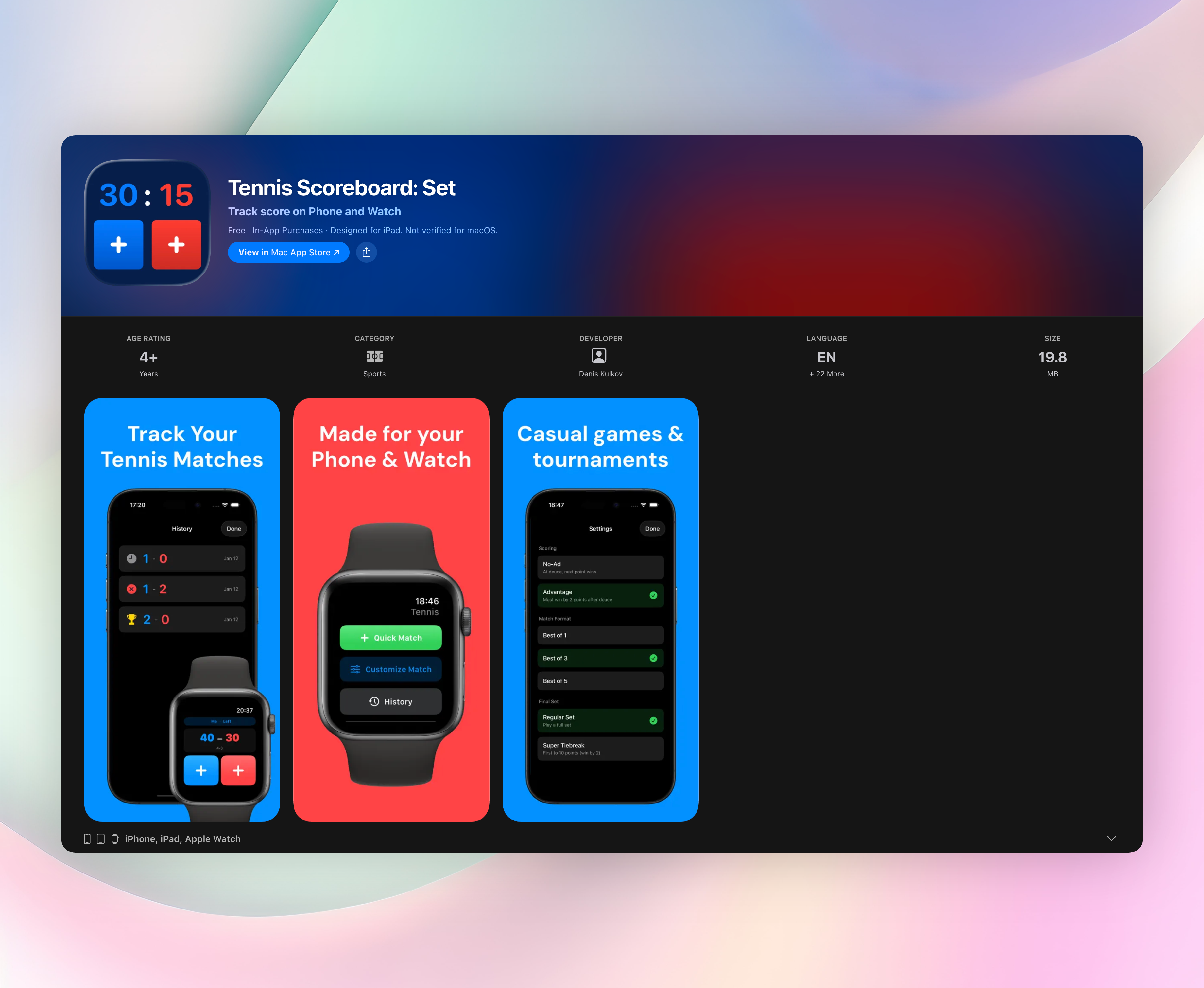
A group trying Fast4 for the first time tends to lose track of the deciding points and the 3–3 tiebreak. Tennis Scoreboard, a tennis scoreboard app for iPhone and Apple Watch that tracks match scores, ships Fast4 as a selectable format alongside standard sets, so nobody has to score it by hand while learning the rules.
No-ad scoring: one point ends the game
No-ad scoring in tennis is a modifier rather than a format. Bolt it onto a pro set, a short set, or a standard set and nothing else changes. At deuce, one point decides the game, and the receiver chooses which side to take it on. Under the ITF's no-ad appendix, mixed doubles plays that deciding point same gender against same gender.
It's standard in NCAA college dual matches, an option in plenty of USTA league and junior events, and used in ATP and WTA tour doubles. What it removes is the tail: the game that goes to deuce six times. A routine hold takes exactly as long as it always did. For the underlying math, see how deuce and advantage scoring works.
The 10-point match tiebreak
A match tiebreak in tennis replaces an entire deciding set. First to 10 points, win by two, change ends every six points, same serving pattern as any tiebreak — one point, then two at a time.
It stands in for the third set in ATP and WTA tour doubles and in most club doubles leagues. Don't confuse it with the deciding-set tiebreak all four Grand Slams adopted in 2022: that one is also played to 10 points, but it happens at six games all after a full final set rather than in place of one. Both are covered in tiebreak rules.
Every shortened format side by side
| Format | Games to win a set | Tiebreak trigger | Deuce handling | Typical use |
|---|---|---|---|---|
| Standard set | 6, win by 2 | 6–6, first to 7 | Advantage, or no-ad if agreed | Tournaments, most singles |
| 8-game pro set | 8, win by 2 | 8–8, first to 7 (10 if announced) | Advantage or no-ad | Ladders, club matches, dual matches |
| Short set (ITF) | 4, win by 2 | 4–4, first to 7 | Advantage or no-ad | Round robins, juniors |
| Fast4 | 4, tiebreak at 3–3 | 3–3, first to 5, sudden death at 4–4 | No-ad always | Club nights, junior events |
| 10-point match tiebreak | Replaces the set entirely | It is the tiebreak | Not applicable | Deciding set in doubles |
Which format fits your session
A one-hour court booking. Fast4 best of three, or an 8-game pro set with no-ad. Warm-up eats the first ten minutes, and a standard best-of-three doesn't fit in what's left — see how long a tennis match actually runs.
A league night on limited courts. An 8-game pro set with no-ad is the most predictable block you can schedule: a ceiling of sixteen games plus a tiebreak, and no game running past a single deciding point.
A junior event or round robin. Fast4 or short sets. The fixed four-game target keeps the draw on schedule, and players get three or four matches instead of one long one.
Social doubles. Two standard sets plus a 10-point match tiebreak. Everyone knows the format, and the third set can't spiral.
FAQ
How many games do you play in a pro set?
Eight, with a two-game margin, so 8–6 finishes the match and 8–7 doesn't. At 8–8 a tiebreak decides it. Games are scored normally unless the event adds no-ad.
Is Fast4 the same as a short set?
No. An ITF short set is first to four games with a two-game margin and a 7-point tiebreak at four-all. Fast4 goes to its tiebreak a game earlier, at three-all, and that tiebreak runs to five points with a sudden-death point at 4–4.
What happens at 8–8 in an 8-game pro set?
You play a tiebreak for the match. USTA events default to the 7-point tiebreak, won by two points. A committee can specify a 10-point tiebreak instead, provided it announces that before the event.
Does no-ad scoring actually save time?
It caps the worst case more than it shortens the average game. Multi-deuce games disappear, which is what makes a schedule hold, but a straightforward hold takes just as long as it always did.
Can a match tiebreak replace the third set?
Yes, that's what it exists for: first to 10 points, win by two, in place of a deciding set. ATP and WTA tour doubles use it, and so do most club leagues. It is not the same as the 10-point tiebreak played at 6–6 in a Grand Slam deciding set.
Free Tennis tools
- Grand Slam Format GuideFind out how many sets Wimbledon and the other Grand Slams require. Choose a tournament and event to compare sets, tiebreaks and surfaces.
- Junior Tennis Racket Size ChartEnter a child's age and height to see the recommended junior racquet length, a full sizing chart and the matching ball colour stage.
- Tennis Ball Diameter ReferenceUse this tennis ball diameter reference to check the published size range for an adult or junior ball in the unit you need.
- Tennis Ball Dimensions ChartCompare tennis ball dimensions for standard, slow, fast, high-altitude and junior stage balls. Choose a display unit to see diameter, circumference and available weight ranges.
- Tennis Ball Weight ReferenceChoose a supported tennis ball type and display unit to see its standard mass range. This reference helps with choosing and identifying tennis balls.
- Tennis Court Dimensions ConverterConvert official singles and doubles court geometry into feet, meters, or yards, with the key tennis court marking distances included.
- Tennis Grip Size CalculatorMeasure your hand with the ruler method to get a recommended tennis racket grip size in US and European notation, plus guidance when you fall between sizes.
- Tennis Match SimulatorEnter each player's serve point-win probability to calculate exact match odds, set and game probabilities, and the most likely scorelines.
- Tennis Match Time CalculatorSee how many sets in a tennis match format, plus a planning range for games and court time.
- Tournament Rounds CalculatorEnter players or teams and a draw type to see how many round in tennis tournaments, total matches, first-round byes and each round's match count.